
Fragrance Market Signals: Mistakes Small Brands Make on a First Order
Most small fragrance brands do not fail because they picked the wrong scent; they fail because they treated a trend headline as a demand forecast. A signal tells you what consumers are curious about, not what they will pay for, and the gap between those two is where first orders usually go wrong. The fix is to turn every trend you like into a testable question about price, format and usage before you commit production money.
Key takeaways
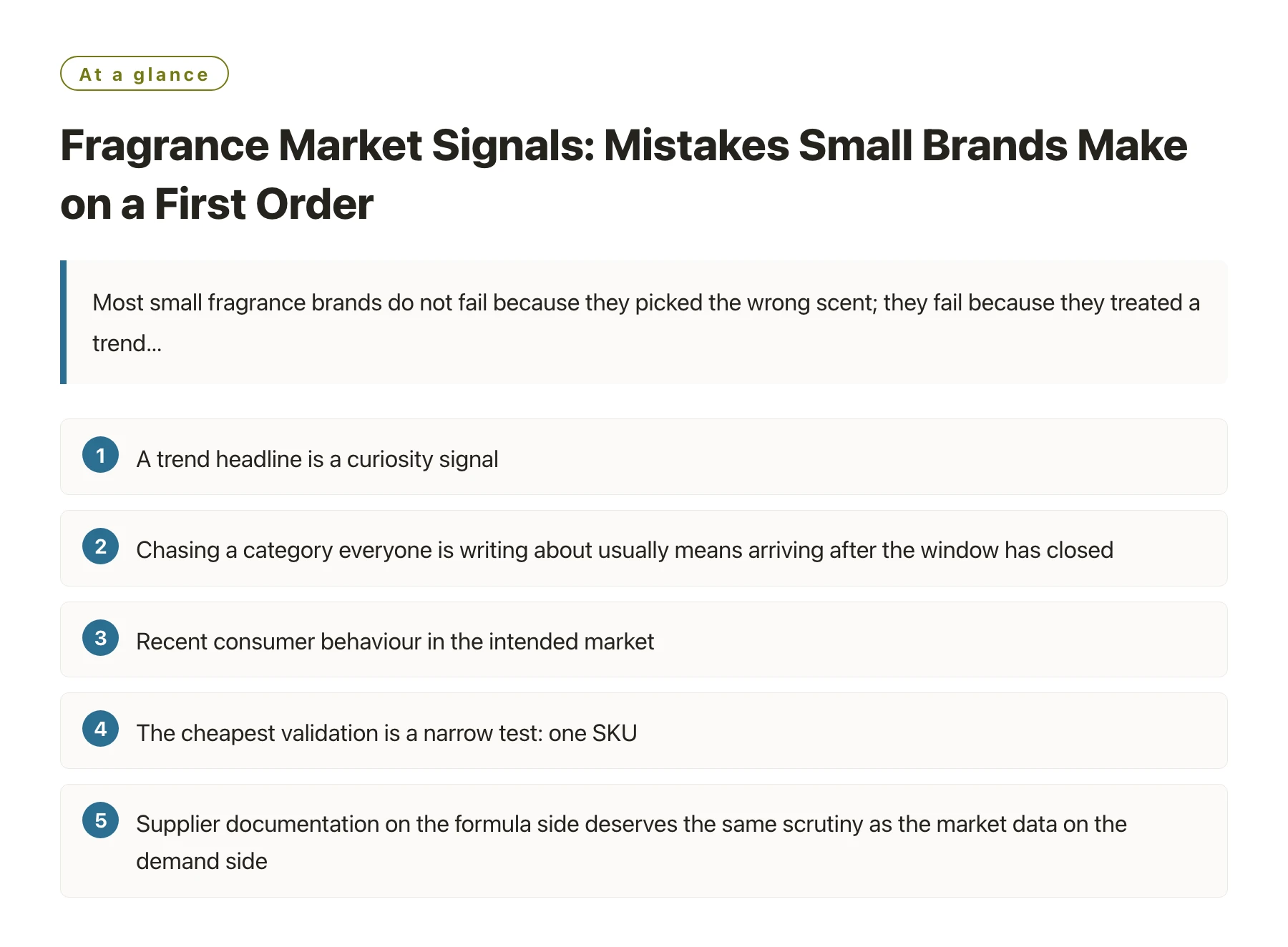
- A trend headline is a curiosity signal, not a demand forecast; it has to be translated into price, format and usage behaviour before it becomes an order.
- Chasing a category everyone is writing about usually means arriving after the window has closed, because reporting lags consumer behaviour.
- Recent consumer behaviour in the intended market, checked against regulatory and safety constraints, is the strongest evidence a small brand can afford.
- The cheapest validation is a narrow test: one SKU, one channel, a short feedback loop, rather than a full line built around a hunch.
- Supplier documentation on the formula side deserves the same scrutiny as the market data on the demand side, because compliance surprises occur after production.
A founder preparing a small first order reads the same sources everyone reads: trade press summaries, market research headlines, social conversations about scent. The skill that separates a good first order from an expensive experiment is not finding signals; it is refusing to over-read them.
This article walks through the interpretation mistakes that cost small brands the most, and the discipline that replaces each one. The persona on the page is a first-time founder, but the framework applies to any buyer who has one shot at a category.
Mistake one: treating a headline as a forecast
Market research firms publish regular press reports on beauty and fragrance categories, and those reports are useful precisely because they describe broad positioning and consumer interest rather than individual sales guarantees [1]. Read them as survey data, not as a purchase order. A headline saying a note or format is growing tells you where attention is; it says nothing about whether your audience, at your price point, will act on it.
The corrective habit is to write the headline down as a hypothesis and then demand evidence for three things: who the buyer is, what the product will cost them, and when they will use it. If none of those three have an answer, the trend has not been translated yet.
Mistake two: arriving late because reporting lags behaviour
Press coverage and search interest peak after a category has already grown, because both respond to what consumers are already doing. A small brand that builds its first order from current headlines is therefore building for the past peak, not the next one.
The countermove is to look for the second derivative: not which category is growing, but which small sub-behaviours are just beginning - a usage occasion gaining ground, a format detail being requested repeatedly, a price band filling up. Those appear in retail conversations and in your own customer inquiries long before they appear in the trade press.
Mistake three: ignoring the regulatory and safety filter
A signal can be real and still be unshippable through your chosen route to market. Fragrance products sold in the European Union must have a responsible person and a product information file assembled before they reach the market, not after the container lands [2]. Similar surprises hide in allergen labelling, restricted ingredient lists and packaging rules, and each one changes the viable product definition.
Run the trend through the compliance filter early, ideally before sampling. The industry's own safety framework - usage restrictions published on the basis of safety assessments, and the position of the international fragrance association on responsible use - tells you which parts of the idea survive contact with regulation [3]. A raw-material or labelling constraint can kill a format that looked perfect in the trend report.
Mistake four: scaling a hunch into a full line
The most expensive version of this mistake is ordering a whole range because the category feels right. A first order should be narrow on purpose: one scent, one format, one channel with a short feedback loop. That structure converts the market's response into usable data within weeks instead of quarters.
If the test works, the second order scales the winner; if it fails, the loss is bounded and the learning is specific. A supplier that can handle small production runs and later grow them becomes part of this strategy, which is what their OEM/ODM manufacturing services are for: small batches to learn, larger batches to earn.
Mistake five: trusting the demand side and skipping the supply side
Founders routinely spend days on market data and minutes on the documentation the manufacturer holds, then discover at the filling stage that the formula or the label cannot meet the destination market's rules. The two sides deserve equal time, because both determine whether the product clears customs.
The evidence file to request
Ask for the batch record structure, the ingredient information, and the document pack the manufacturer ships with exports. This is the same discipline that private label fragrance production demands: the brand owns the market, the manufacturer owns the repeatability, and each side's claims must be checkable. A partner that publishes its scope and certification list, such as Xuelei's website, makes this verification faster simply because the claims exist in writing.
A useful discipline for a small brand: keep a running list of signals you like, and give each one exactly one testable product question. If a signal cannot produce one, drop it. The list is your protection against buying your own enthusiasm.
Sources
- Mintel Press Centre —— Mintel's press releases on consumer and beauty market research, including fragrance and personal care trend reporting.
- European Commission: Cosmetics in the EU —— The European Commission's overview of EU cosmetics rules, including the responsible person, product information file and safety report requirements.
- International Fragrance Association (IFRA) —— IFRA is the global trade association of the fragrance industry; its site publishes the IFRA Standards, positions and science on the safe use of fragrance materials.
Frequently asked questions
Where should a small fragrance brand look for market signals?
Start with retail conversations, customer inquiries and the category reports from market research firms, then filter everything through the regulatory requirements of the destination market. The signal matters less than the test you build from it.
How do I know if a trend is still early?
Early trends show up in repeated small behaviours - a usage occasion, a format detail, a price band - before they appear in trade headlines. If the press already covers it, the mass market is usually close behind, which is late for a small first order.
Should I order multiple scents to test a trend?
Usually not on the first order. One scent, one format and one channel give you a readable result. Multiple variants blur the signal and multiply the cash at risk before you know if the category works at all.
How much market research is enough before a first order?
Enough to name the buyer, the price and the usage occasion with confidence, plus confirmation that the product can be legally sold in your market. Beyond that, a real small order generates better data than another month of reading.
What role do safety standards play in reading fragrance trends?
A trend describes demand; safety standards describe what can legally be shipped. If the format conflicts with ingredient restrictions or labelling rules in the destination market, the trend is not an opportunity for that route to market.
Need a guaranteed cash offer on your KC home?
Tell us about the property. Most homeowners receive a written offer within 24 hours — and we close on the date you choose.
Get My Guaranteed Offer